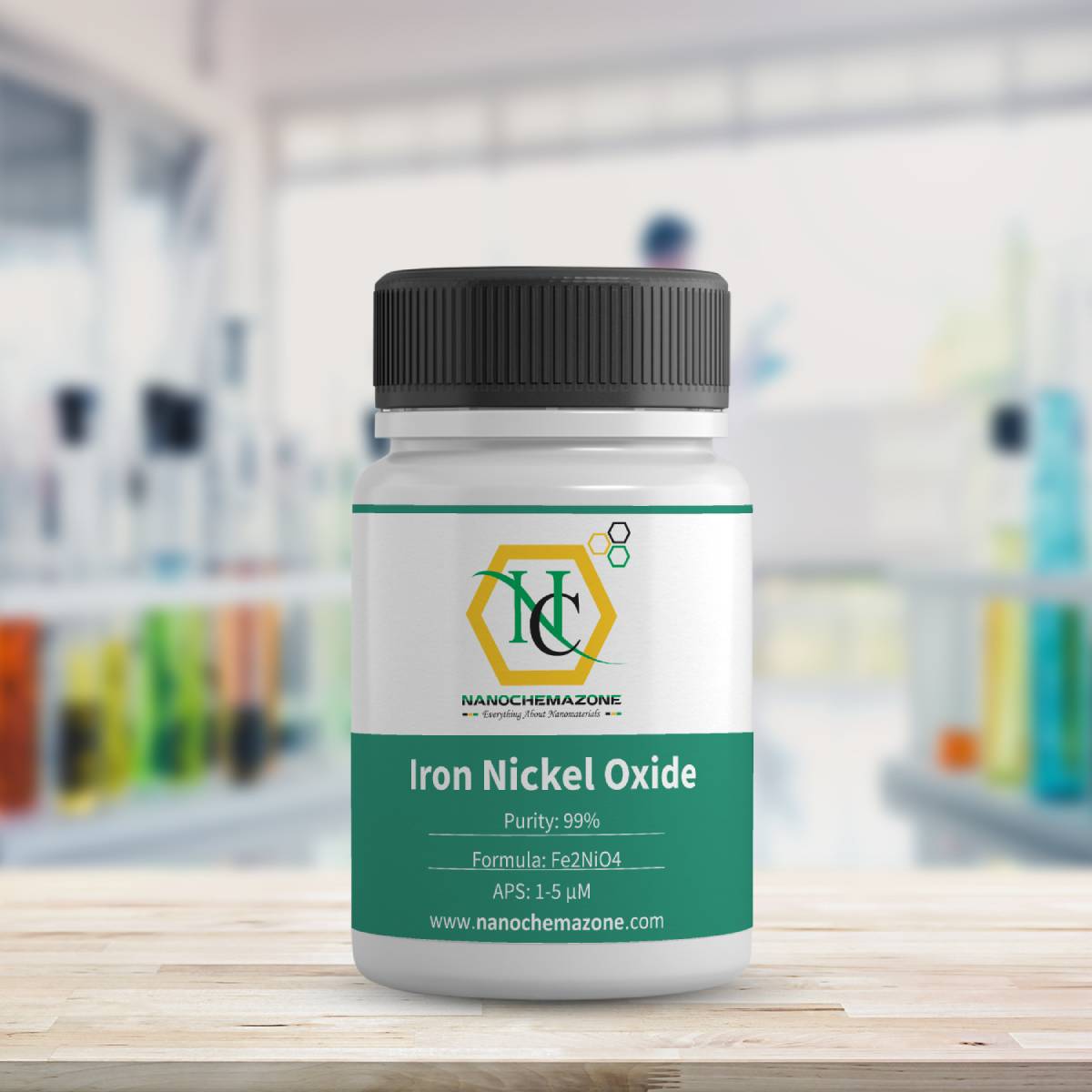
Iron Nickel Oxide
| Product |
|
| Colour |
Dark Brown Powder |
| Purity |
99% |
| Particle Size |
1-5µM (Customizable) |
| Ingredient/MF |
Fe2NiO4 |
| Product Code |
NCZ-CP-376/20 |
| CAS Number |
12168-54-6 |
| Density |
5.368 g/cm3 |
| Melting point |
N/A |
| Boiling Point |
N/A |
| Molecular Weight |
234.38 |
| Exact Mass |
233.784876 |
Iron Nickel Oxide Description
Iron is a Block D, Group 8, Period 4 element with an atomic weight of 55.845. The number of electrons in each of Iron’s shells is 2, 8, 14, 2 and its electron configuration is [Ar] 3d6 4s2. The iron atom has a radius of 126 pm and a Van der Waals radius of 194 pm.
Iron was discovered by humans before 5000 BC. In its elemental form, iron has a lustrous grayish metallic appearance. Iron is the fourth most common element in the Earth’s crust and the most common element by mass forming the earth as a whole.
Iron is rarely found as a free element, since it tends to oxidize easily; it is usually found in minerals such as magnetite, hematite, goethite, limonite, or siderite. Though pure iron is typically soft, the addition of carbon creates the alloy known as steel, which is significantly stronger.
Nickel:
Nickel is a Block D, Group 4, Period 4 element with an atomic weight of 58.6934. The number of electrons in each of nickel’s shells is [2, 8, 16, 2] and its electron configuration is [Ar]3d8 4s2. Nickel was first discovered by Alex Constedt in 1751.
The nickel atom has a radius of 124 pm and a Van der Waals radius of 184 pm. In its elemental form, nickel has a lustrous metallic silver appearance. Nickel is a hard and ductile transition metal that is considered corrosion-resistant because of its slow rate of oxidation.
It is one of four elements that are ferromagnetic and is used in the production of various type of magnets for commercial use. Nickel is sometimes found free in nature but is more commonly found in ores. The bulk of mined nickel comes from laterite and magmatic sulfide ores. The name originates from the German word kupfernickel, which means “false copper” from the illusory copper color of the ore.
Related Information
Please email us for the customization.
Email: contact@nanochemazone.com
Please contact us for customization and price inquiry
Note: We supply different size ranges of Nano and micron as per the client’s requirements and also accept customization in various parameters.